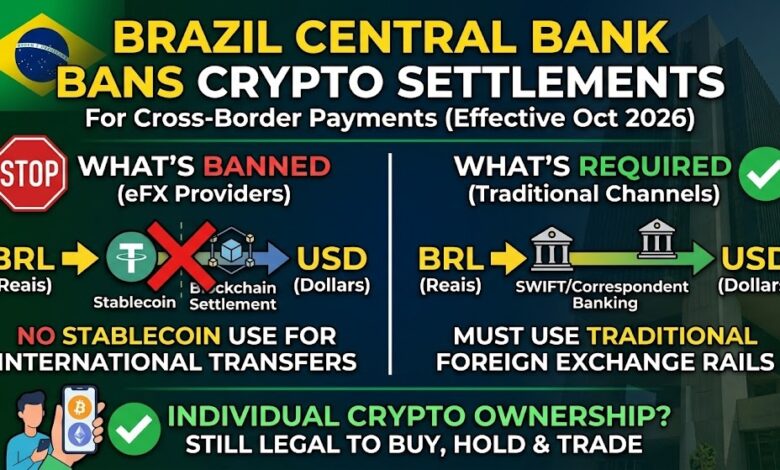
On April 30, 2026, Brazil’s central bank (the Banco Central do Brasil, or BCB) published Resolution No. 561. This regulation, which officially takes effect on October 1, 2026, bans electronic foreign exchange (eFX) providers from using cryptocurrencies specifically stablecoins like USDT and USDC, as well as Bitcoin to settle international cross-border payments.
The “Back-End Plumbing” Problem
To understand the ban, it helps to look at how remittance companies were moving money.
- Before the ban: A Brazilian user wants to send money to the US. A local fintech app takes their Brazilian reais, converts the funds into a stablecoin (like USDT), zips those tokens across a blockchain to a foreign partner, and cashes them out into US dollars on the other side. It was fast, cheap, and completely bypassed traditional banking infrastructure.
- After October 1: The central bank is closing this loophole. Licensed payment providers are now legally required to route all cross-border transactions through traditional foreign exchange channels or non-resident real-denominated accounts inside Brazil. The underlying settlement rail can no longer touch crypto.
What Is NOT Banned
The regulation is highly specific and does not ban individual crypto ownership or trading. If you are a citizen or investor in Brazil, you can still buy, sell, trade, and hold digital assets through authorized Virtual Asset Service Providers (VASPs). It is strictly a ban on the corporate back-end settlement mechanisms used by payment operators.
Why the Central Bank Stepped In
Brazil is a massive crypto market, moving roughly $6 billion to $8 billion a month, with stablecoins accounting for about 90% of that volume. The BCB intervened for two main reasons:
- Tax and Anti-Money Laundering (AML) Blind Spots: When money moves through traditional correspondent banks, the central bank has complete visibility over every step of the transaction. When millions of dollars are settled via a USDT transfer on a blockchain network like Tron, it vanishes from the central bank’s regulatory radar. Brazil’s tax authority (Receita Federal) flagged this as a massive blind spot that made tracking capital flows and preventing money laundering nearly impossible.
- Monetary Sovereignty: Most stablecoins used in Brazil are dollar-pegged tokens issued by foreign companies (e.g., Tether in the British Virgin Islands or Circle in the US). By allowing regulated domestic businesses to rely on these foreign tokens for national cross-border flows, the BCB felt it was losing control over its own payment infrastructure.
Who is Affected?
The immediate burden falls on fintech companies and remittance platforms that built their business models around stablecoin settlement for speed and cost advantages. Companies like Wise, Nomad, and Braza Bank will have to completely restructure their workflows back to traditional banking rails.
Firms that are not yet officially authorized to operate as eFX providers can keep running under transition rules, but they must apply for authorization by May 31, 2027, and they still have to drop crypto settlement immediately. Ultimately, the return to older, more heavily regulated traditional banking rails means that these companies will face higher compliance costs which will likely be passed down to consumers in the form of higher transfer fees.