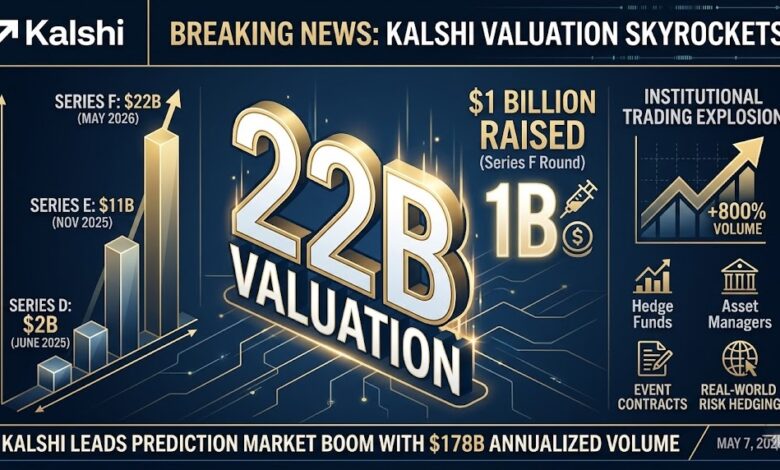
Kalshi, a platform where people can trade on the outcomes of real-world events (from politics to economics and pop culture), just closed its Series F funding round. They brought in a staggering $1 billion in fresh capital. This new money values the company at $22 billion. The round was led by Coatue Management, a massive tech-focused investment firm. However, the list of other participants reads like a “who’s who” of Wall Street and Silicon Valley, including Sequoia Capital, Andreessen Horowitz, Morgan Stanley, Paradigm, IVP, and ARK Invest.
To put this in perspective, this is Kalshi’s third major funding round in just seven months, and their valuation has effectively doubled each time. Back in June 2025, they were valued at $2 billion. By November 2025, they hit $11 billion. Now, they are sitting at $22 billion. That kind of hyper-growth is incredibly rare, especially outside of the AI sector.
Historically, prediction markets were seen as a bit of a niche mostly retail traders betting on election outcomes or pop culture. However, this new valuation is completely driven by a massive shift toward institutional adoption.
- Institutional trading volume on Kalshi has exploded by 800% over the last six months.
- Annualized trading volume on the platform has more than tripled, jumping from $52 billion to $178 billion.
- The company is reportedly generating over $1.5 billion in annualized revenue.
- Kalshi now commands over 90% of the U.S. prediction market activity and the majority of the global volume.
Hedge funds, asset managers, proprietary trading firms, and insurance companies are no longer viewing Kalshi as a betting site. They are using Kalshi’s “event contracts” as core financial infrastructure to hedge against real-world risks. For example, if an insurance company wants to hedge against a specific regulatory change or an economic data release, they can now trade on that exact outcome.
Kalshi’s CEO, Tarek Mansour, has explicitly stated that they believe event contracts are on their way to becoming a trillion-dollar market. They are going to use this $1 billion war chest to build out tools specifically for the big players. Expect to see deeper integrations with institutional brokers, new block trading capabilities (which allow massive trades to happen without instantly moving the market price), and complex risk management products.
It is worth noting that it is not entirely smooth sailing. While Kalshi has the major advantage of being federally regulated by the Commodity Futures Trading Commission (CFTC) in the U.S., they are still fighting battles at the state level. Several states, like Nevada and Arizona, have recently pushed back or pursued legal action, debating whether these markets constitute illegal state gambling or federally sanctioned financial derivatives.
Despite these state-level headaches, the federal backing and the sheer amount of institutional money pouring in suggest that Wall Street is betting heavily that prediction markets are here to stay.